Three rungs. Different proofs.
A serial lookup, a matching seal, and a live chip tap are not the same claim. Read the rung you used — never treat them as equal.
- 1. Serial or QRA record match
- 2. SealMatch by eye
- 3. Live chip tapProves the original
What each rung proves
The three rungs first. Then the other marks that live on a record — they speak for the file, not the object in your hand.
- 01
Serial or QR
A record match
The number or printed square opens the matching public record. It shows we hold a file for that serial. Anyone can copy a printed code, so this does not prove the physical work is present.
- 02
Seal
Match by eye
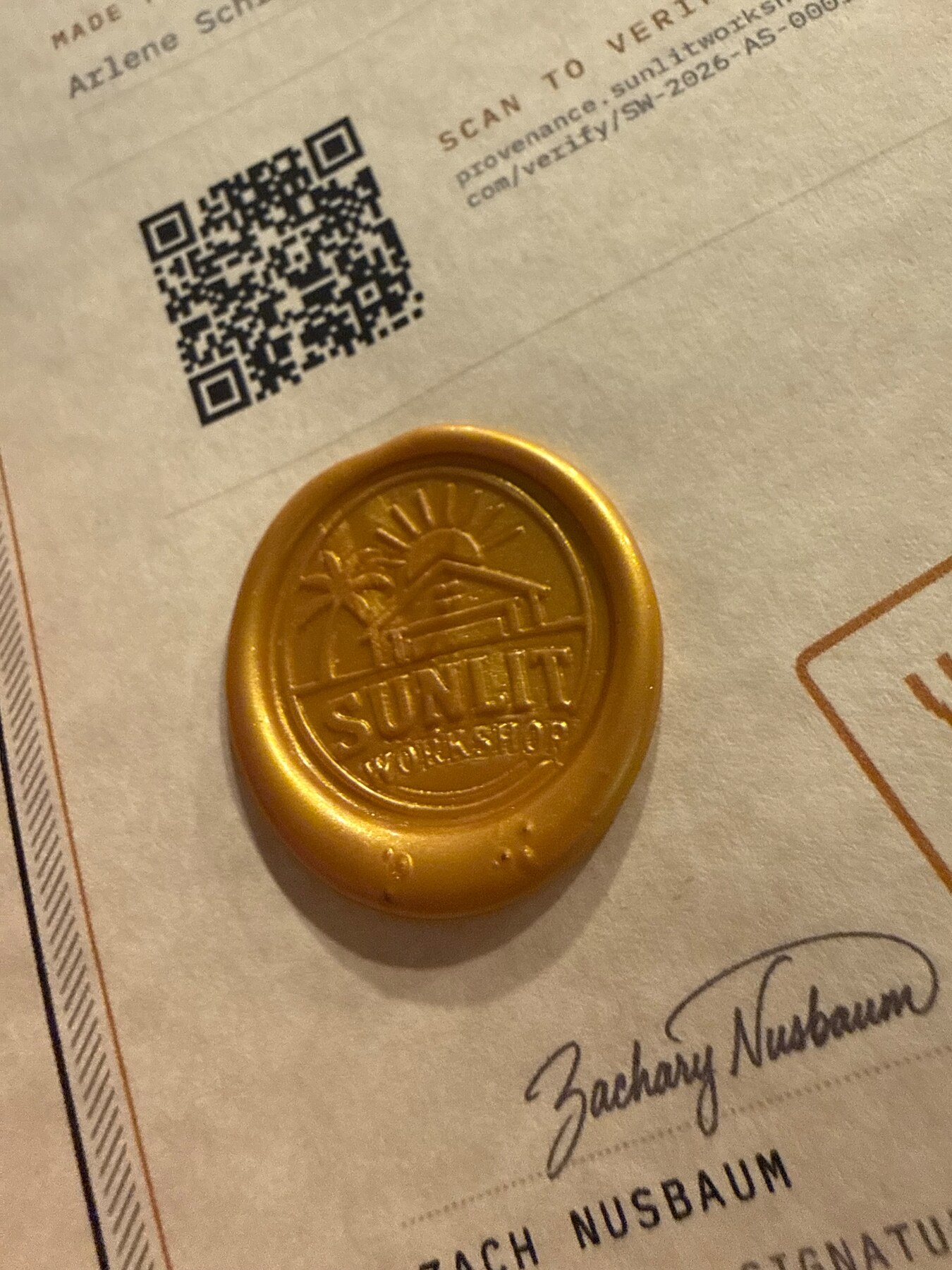
Compare the hologram on the piece to the one on the record — same look, same number where one is printed. This is a visual check you do yourself, not a cryptographic proof.
- 03
Live chip tap
Proves the original
On supported works, the secure chip creates a new response each time. Sunlit Verify checks that response in the app. That is the only method that proves the registered chip — and therefore the original — answered just now.
- 04
Static tap tag
A link that stays the same
This NFC tag stores a fixed link and opens it when tapped. It is a convenient alternative to the QR code, with the same limit: the link can be copied, so the tap proves the destination rather than the presence of the original tag.
- 05
Certificate tag
The tag attached to the paper certificate
This tag joins the paper certificate to the Work’s public serial and to the certificate’s own registered tag. It holds a signed set of identifying fingerprints for the record and proof files—not the full files—so a substitution or mismatch can be noticed.
- 06
The Work’s digital identity certificate
An identity file for one Work
This independently checkable file names the public serial, verification page, and a unique fingerprint. Sunlit’s certificate authority issues it. If the Work is unfinalized, the certificate is revoked and can no longer be presented as current. It proves the workshop issued an identity for that serial — not that the piece in front of you is the original.
- 07
The public log
A dated stamp anyone can check
When a record is signed, a fingerprint of it is written to a public log that nobody can edit or erase — like a notary’s dated stamp. Anyone can look up the entry and confirm this exact record existed, signed by Sunlit Workshop, at that time. The log proves the record and the date; it says nothing about the physical piece.
The words on a record
One plain line each. The technical names stay in brackets for anyone who wants them.
- Serial
- The workshop’s permanent number for one Work, such as SW-2026-0042. It opens the public record and never changes.
- Hologram
- The seal on the piece. Match it by eye to the one shown on the record — same look, same number where one is printed.
- Chip
- An NFC tag locked to the serial. A live secure chip answers freshly on each tap; a static tag only opens a link.
- Digital certificate (X.509)
- A digital ID card for one Work, issued by the workshop’s own certificate authority. Each Work has two: an identity certificate that names the serial and the record page and signs nothing, and a signing certificate that signs the certificate PDF, countersigns the record, and files a second public-log entry over the same fingerprint. Sunlit Workshop signs the record and publishes it to the public log. Neither certificate proves the physical piece.
- Public log (Rekor)
- An open, append-only ledger where a fingerprint of the signed record is filed. It proves the record existed and was signed at that time; it does not prove the physical piece. Illustrated guide.
- Fingerprint (SHA-256)
- A short code computed from a whole file. Change one byte and the code changes, so a matching fingerprint means an identical file.
- Timestamp (OpenTimestamps / RFC 3161)
- Independent, hard-to-fake dates on the certificate PDF — a Bitcoin anchor and an RFC 3161 token — kept under Technical proofs. The public log entry above is the same kind of check without any file from us.
Evidence, stated carefully
The public record establishes the identity Sunlit assigned to the Work and preserves its history. A QR scan or static tap only matches a mark to that record.
A successful live secure tap adds evidence that the registered chip answered freshly. It does not replace inspection of the physical Work, its condition, or its chain of custody.
The digital certificate and the public log speak for the record, not the object. One proves the workshop issued an identity for that serial; the other proves the record existed and was signed at a certain time. Neither proves the piece in your hand.
Look up a serial